TL;DR
- Guy Kawasaki's 10/20/30 rule limits presentations to 10 slides, 20 minutes, and a 30-point minimum font size.
- Ten slides forces you to cut everything that doesn't earn its place. Every extra slide dilutes the ones that matter.
- The 20-minute cap is strategic. Attention drops sharply after 15-20 minutes, and remote audiences drop out entirely if you run long.
- A 30-point font physically prevents text overload. If your content doesn't fit, you have too much content on the slide.
- Breaking this rule is fine as long as you can explain exactly why for that specific audience.
- AI tools like Presentations.AI make it easier to stay inside the rule by generating focused drafts with readable layouts from the start.
Guy Kawasaki’s 10/20/30 rule for presentations was originally aimed at entrepreneurs pitching investors, but it's become one of the most widely referenced presentation frameworks in business. It forces you to cut the filler, respects your audience's time, and makes you actually think about what matters before you open your slide editor.
It’s very easy to keep adding slides, shrinking text, and running long. This post breaks down each part of the 10/20/30 rule, why it still holds up in 2026, and how to build a deck that actually sticks to it.
What Is the 10/20/30 Rule for Presentations?
The 10/20/30 rule is a presentation framework created by Guy Kawasaki, a longtime entrepreneur and venture capitalist at Silicon Valley. He published it as a direct response to the bloated pitch decks he saw daily. It comes down to three hard constraints.
10 Slides: Forces You To Stick To Essentials
Ten slides forces you to distill your message to its essential parts. For a startup pitch, Kawasaki originally mapped those ten slides to: problem, solution, business model, underlying magic, marketing and sales, competition, team, projections, status and timeline, and summary/call to action. The principle applies just as well to sales decks, quarterly reviews, and project proposals. If you want to see how a focused pitch deck is structured, this guide to pitch deck structure walks through each slide in detail.
Why ten specifically? Kawasaki's observation was simple: A normal human can't process more than ten concepts in a single sitting. Every slide beyond ten dilutes the ones that actually matter.
20 Minutes: Even If You Have an Hour
The rule says your presentation should last no longer than twenty minutes, even if your meeting slot is sixty. The remaining time is for questions, discussion, and the inevitable five minutes lost to IT setup and "can everyone see my screen?"
Twenty minutes also accounts for how attention actually works. Research on cognitive load consistently shows that focus drops sharply after the 15-20 minute mark. Keeping it short is strategic, not lazy.
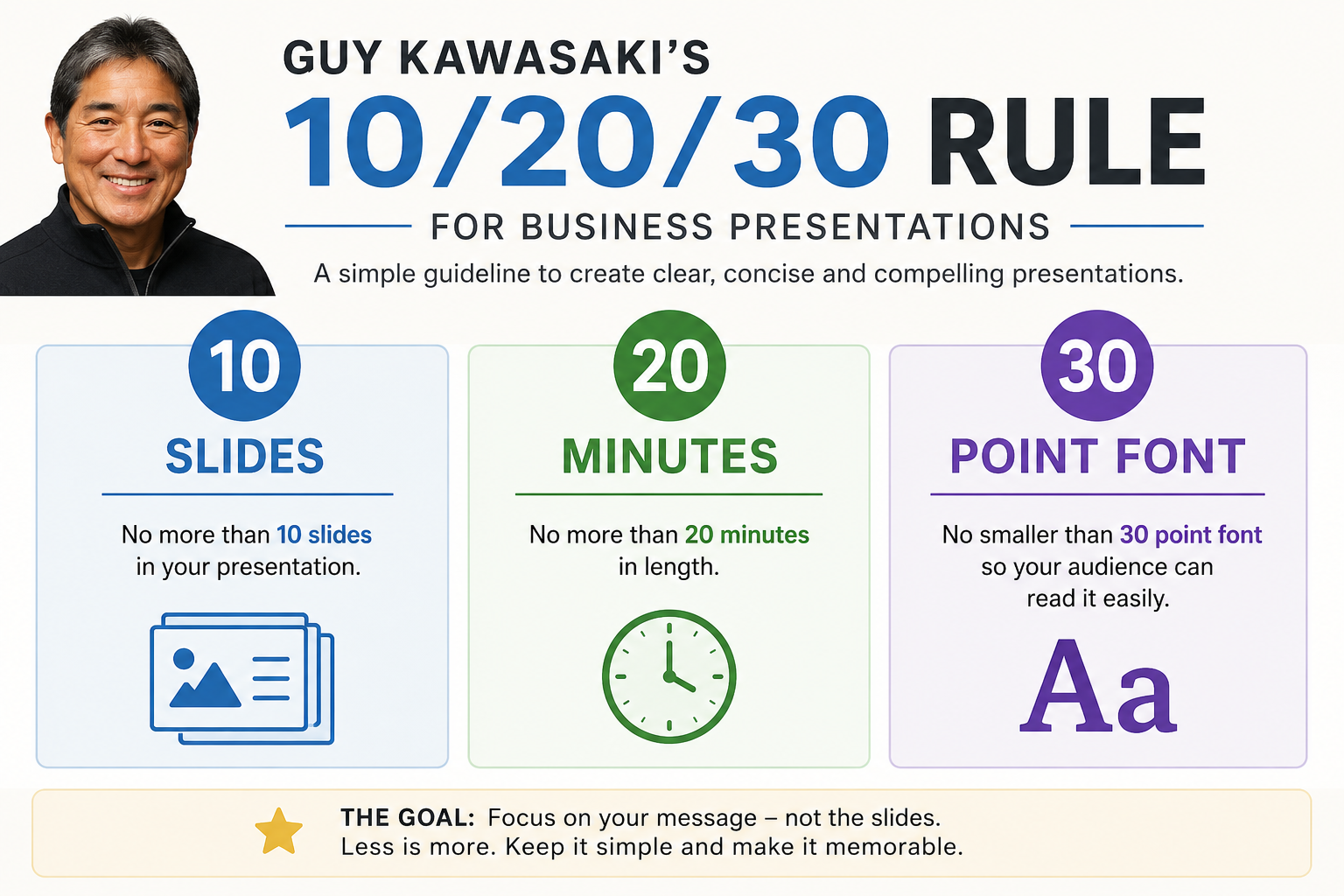
30-Point Font: The Constraint That Changes Everything
This is the piece most people push back on. A thirty-point font feels enormous when you're used to cramming paragraphs onto slides. That's the point.
A 30-point minimum does two things at once. First, it makes your slides readable from the back of a conference room, on a laptop in a Zoom call, or on a phone when someone opens your shared link later. Second, it physically limits how much text fits on a slide, which means you have to talk about your content instead of reading it. Your slides become prompts for your narrative, not a substitute for it.
Kawasaki put it bluntly: If you need smaller text, it's because you don't know your material well enough. Harsh, but not wrong.
Why 10/20/30 Works
Any one of these rules in isolation helps. But the real power is in the combination. Ten slides keeps you focused. Twenty minutes keeps your audience engaged. Thirty-point font keeps you honest about what actually belongs on screen. They're interlocking constraints. Break one, and the other two start to fall apart.
The 10/20/30 rule is about building a presentation where every slide earns its place, every minute respects your audience, and every word on screen is big enough to actually read. That's a higher bar than most decks clear, and it's exactly why the framework has lasted nearly two decades.
Real Decks That Follow the Rule
The easiest way to understand the rule in practice is to look at decks that actually followed it.
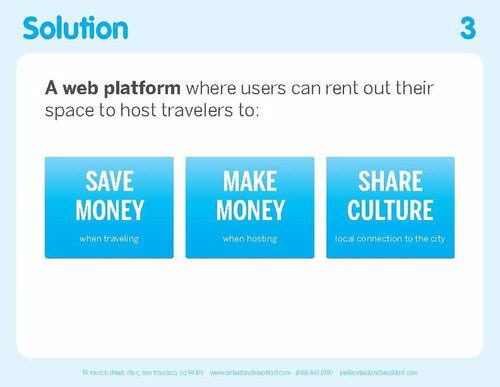
Airbnb (2009 seed round, $600K raised): Exactly ten slides. Problem, solution, business model — each slide carried one idea, nothing more. The business model was a single line: "We take a 10% commission on each transaction." Now taught in business schools.
YouTube (2005 Series A, $3.5M raised): Ten slides at a time when the platform had fewer than 10,000 users. The deck told a complete story without asking investors to fill in gaps. Sequoia invested; Google acquired YouTube sixteen months later for $1.65 billion.
Dropbox (2007, $1.2M from Sequoia): Slightly over ten slides but one of the leanest decks of its era. The problem was framed in a way anyone could immediately feel, the solution was positioned as obvious, and there was no over-engineering of the narrative.
Guy Kawasaki's own template: He didn't just write the rule — he built a ten-slide deck to demonstrate it. Worth looking at not for the design, but because it makes the constraint tangible.

Uber (2008 seed round) — the counter-example: Twenty-five slides. It still raised $200K, but on the strength of the narrative and timing thesis, not the deck length. Analysts who break it down today consistently point to the bloat as a weakness.
Does the 10/20/30 Rule Still Work in 2026?
Kawasaki published this rule in 2005, when presentations happened in conference rooms and projectors took three minutes to warm up. The way people work has changed significantly since then, and it's worth asking whether a framework built for in-person VC pitches still applies to how meetings actually run today.
The real challenge in 2026 is the hybrid meeting, where part of your audience is sitting in the conference room and another part is joining on a laptop screen from a different floor or a different city. That creates two different viewing conditions at once, and you have to design for both simultaneously.
That's where ten slides matters more than ever. The person in the room and the person on the call are both fighting the same attention battle. Neither of them has the patience for a 40-slide deck, and the person on screen has the added distraction of every other app on their computer.
Twenty minutes matters because hybrid meetings are notoriously hard to manage on time. When people in different locations are coordinating around a shared calendar slot, running long isn't just impolite. It breaks everyone's day.
Thirty-point font matters because your slides now have to be legible on a 27-inch monitor in the conference room AND on a 13-inch laptop screen at someone's desk. Text that looks readable in a projector context can become genuinely hard to parse on a smaller screen.
There's also the asynchronous layer. Decks get shared after meetings via Slack, email, or shared drives.
Someone who wasn't in the room will scroll through your slides on a phone or tablet later. A presentation designed for a 30-point minimum font is a presentation that survives that journey. One built on 11-point text walls does not.
The other thing that hasn't changed, and won't, is attention spans. Your audience's habits have been shaped by formats that demand instant clarity. A presentation that takes three slides to get to the point has already lost people who expect the main idea in the first thirty seconds.
The 10/20/30 rule was ahead of its time in treating brevity as a design principle. That's only become more true as the pace of everything else has accelerated.
For pitches, sales decks, board updates, and project proposals, the 10/20/30 rule is still the best default in 2026. The real challenge isn't knowing the rule. It's actually building a deck that follows it.
The 10/20/30 Rule Across Different Use Cases
Kawasaki built this for VC pitches, but the framework adapts to nearly any business presentation. Here's what ten focused slides look like in three common scenarios:
Sales deck: Customer problem, cost of inaction, your solution, how it works, differentiation, social proof or case study, pricing overview, implementation, ROI, next steps. Ten slides keeps you from turning a sales conversation into a product demo. Your prospect should be talking by slide six.
Quarterly business review: Key metrics, what worked, what didn't, root causes, customer feedback, competitive landscape, strategic priorities, resource needs, timeline, decision points. This is the hardest one to keep to ten slides because stakeholders want detail. Resist. Put the supporting data in an appendix or a linked doc. Your slides should drive the discussion, not replace it.
Investor or fundraising pitch: Problem, solution, market size, business model, traction, go-to-market, competition, team, financials, the ask. This is closest to Kawasaki's original template, and it still works because investors see hundreds of decks and reward clarity.
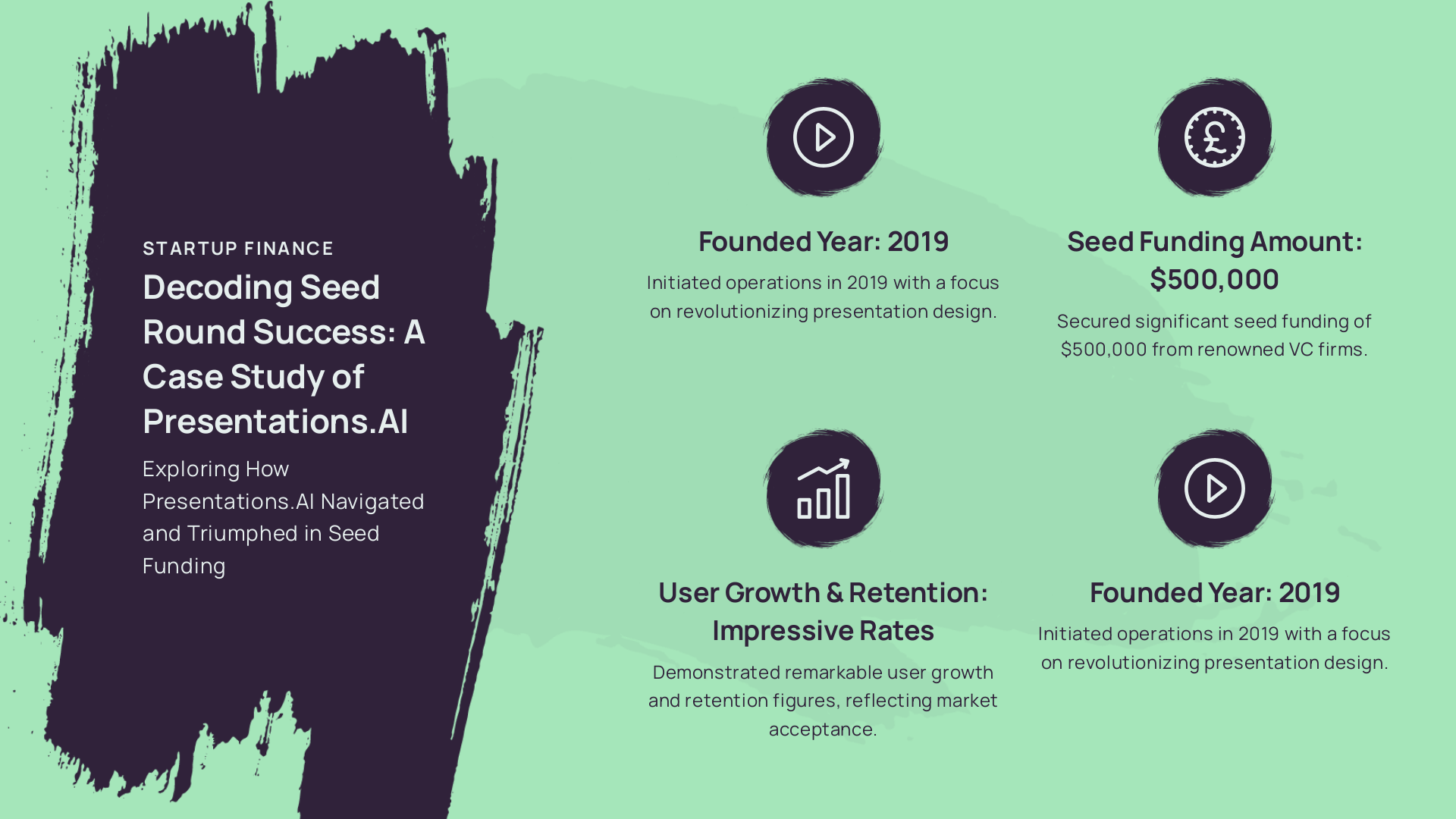
In each case, Presentations.AI's ready-to-use templates give you a focused starting structure for whichever format you're working in. Starting from a focused draft is faster than cutting down a bloated one, and it's easier to stay within ten slides when you never had forty to begin with.
How Presentations.AI Helps You Build Tighter Decks
Most presentation tools are neutral about discipline. Presentations.AI is not. The AI is built to generate focused, well-structured decks from a prompt, a document, or a URL, which means your starting point is already leaner than anything you'd build from a blank slide.
A few things that make a practical difference when you're trying to stay inside the 10/20/30 framework:
- The AI keeps slides content-focused by default. You're not starting with a wall of placeholder text that tempts you to keep filling. Each slide is built around a single idea, which is exactly what the rule asks for.
- Brand Sync handles your colors, fonts, and logo automatically. That removes the urge to spend slide-editing time tweaking aesthetics instead of tightening your message.
- The template library is organized around real use cases, including pitch decks, sales decks, and business reviews. Browse the templates and you'll find structures that already map closely to the ten-slide frameworks described above.
- Flexible templates keep your layouts clean no matter how you edit. So even when you're iterating, the design doesn't break down into something you'd be embarrassed to share.
- The .pptx export means your finished deck opens in PowerPoint, which matters when collaborators or clients are still working in that environment.
- The 10/20/30 rule asks you to be a better editor. Presentations.AI makes that easier by giving you a lean starting point instead of a blank canvas that rewards addition.
The Simplest Presentation Advice Is Still the Best
The 10/20/30 rule has been around for nearly twenty years because it gets something right that most presenters get wrong: the constraint is the point. Ten slides, twenty minutes, and thirty-point font are not arbitrary numbers. They're the result of someone who sat through thousands of bad presentations and worked backwards to figure out what separates the ones that land from the ones that lose a room.
You don't need to follow the rule mechanically in every situation. But if you use it as your default, and only break it when you have a real reason, you'll build better presentations than you would by starting with no constraints at all. Fewer slides means more clarity. Shorter delivery means more respect for your audience. Bigger text means more honest choices about what belongs on screen.
If you want to see what a focused, rule-respecting deck looks like in practice, start with a free template on Presentations.AI and work from there. The structure is already there. You just bring the story.



%20(1).webp)