
Business presentations are crucial when you pitch a new client, update your board, or align your team on quarterly goals. They shape decisions and build or break credibility.
The good news is that making a business presentation that actually works is straightforward. It requires no design skills or hours of formatting. It requires a clear process.
This guide walks you through how to make a business presentation from start to finish. You will learn how to plan your content, structure your slides, and deliver with confidence. Every step is practical, and every tip works regardless of your experience level.
Key Takeaways
- Every strong business presentation starts with a clear purpose and a specific understanding of who will be in the room.
- Structure your slides around one core message per slide so your audience stays focused and never feels overwhelmed by information.
- Clean, minimal design always beats flashy templates because it keeps attention on your ideas instead of competing visual elements.
- Practicing your delivery out loud at least twice helps you find awkward phrasing, fix timing issues, and build real confidence.
- Presentations.AI is a business presentation maker that handles slide structure and design so you can focus entirely on your message.
Define Your Purpose and Know Your Audience
Before you open any software, answer two questions. What do you want this presentation to accomplish? Who is sitting in the room?
Lock In a Single Objective
A presentation that tries to do everything achieves nothing. Decide on one clear outcome before you start building.
Are you trying to close a deal? Get budget approval? Align a team on the next steps? Each goal shapes the content, tone, and slide structure in entirely different ways.
Pro Tip: Write your objective as a single sentence and keep it visible while you build. Every slide should earn its place by supporting that sentence.
Map Your Audience
A board of directors needs a different depth than a project team. A prospective client cares about different proof points than an internal stakeholder.
Think through these factors before you draft a single slide:
- Knowledge level: How much context do they already have on this topic?
- Decision power: Are they approving something, or just gathering information?
- Time tolerance: Do they expect five minutes or thirty?
- Primary concern: What objection or question will surface first?
Match Format to Context
A business presentation with forty slides can work against you. Ten slides and a conversation can outperform a polished deck. A single-page summary can work better than a slideshow entirely.
When you define purpose and audience first, the rest of the process moves faster. You stop guessing what to include. You stop over-designing. You start building slides that actually do their job.
Structure Your Slides Around One Core Message
Slide structure is where most business presentations go wrong. People dump everything they know onto the screen and hope something sticks. That approach overwhelms audiences and buries the actual point. Before you start building, it helps to sketch out a presentation outline so you know exactly which ideas belong in the deck and which ones to cut.
One Slide, One Idea
Every slide should communicate a single message. If you cannot summarize a slide's purpose in one sentence, it carries too much weight. Split it into two slides or cut the weaker idea entirely.
This discipline forces clarity. Your audience processes information one piece at a time. When you respect that, they follow your logic without effort.
Pro Tip: Use your slide title as the key takeaway, not a topic label. Instead of "Q3 Revenue," write "Q3 Revenue Grew 14% Quarter Over Quarter." The audience gets the point before reading a single bullet.
Build a Logical Flow
Strong presentations follow a narrative arc, even when the content is data-heavy. Arrange your slides in a sequence that moves the audience from context to insight to action.
A reliable structure for most business presentations looks like this:
- Opening: State the purpose and why it matters to the people in the room.
- Context: Share relevant background so everyone starts from the same place.
- Core content: Present your key points, evidence, or recommendations in order of importance.
- Action step: Close with a clear ask, next step, or decision needed.
Trim Content
After you draft your slides, review every single one with a hard question: Does this slide move the audience closer to the outcome you defined? If the answer is no, remove it.
Note: A shorter presentation that lands its point will always outperform a longer one that loses the room halfway through.
Most professionals add slides out of insecurity. They feel they need more proof, more context, more backup. The opposite is usually true. Cutting weak slides strengthens every remaining slide.
Pick a Clean Design That Keeps Attention on Your Ideas
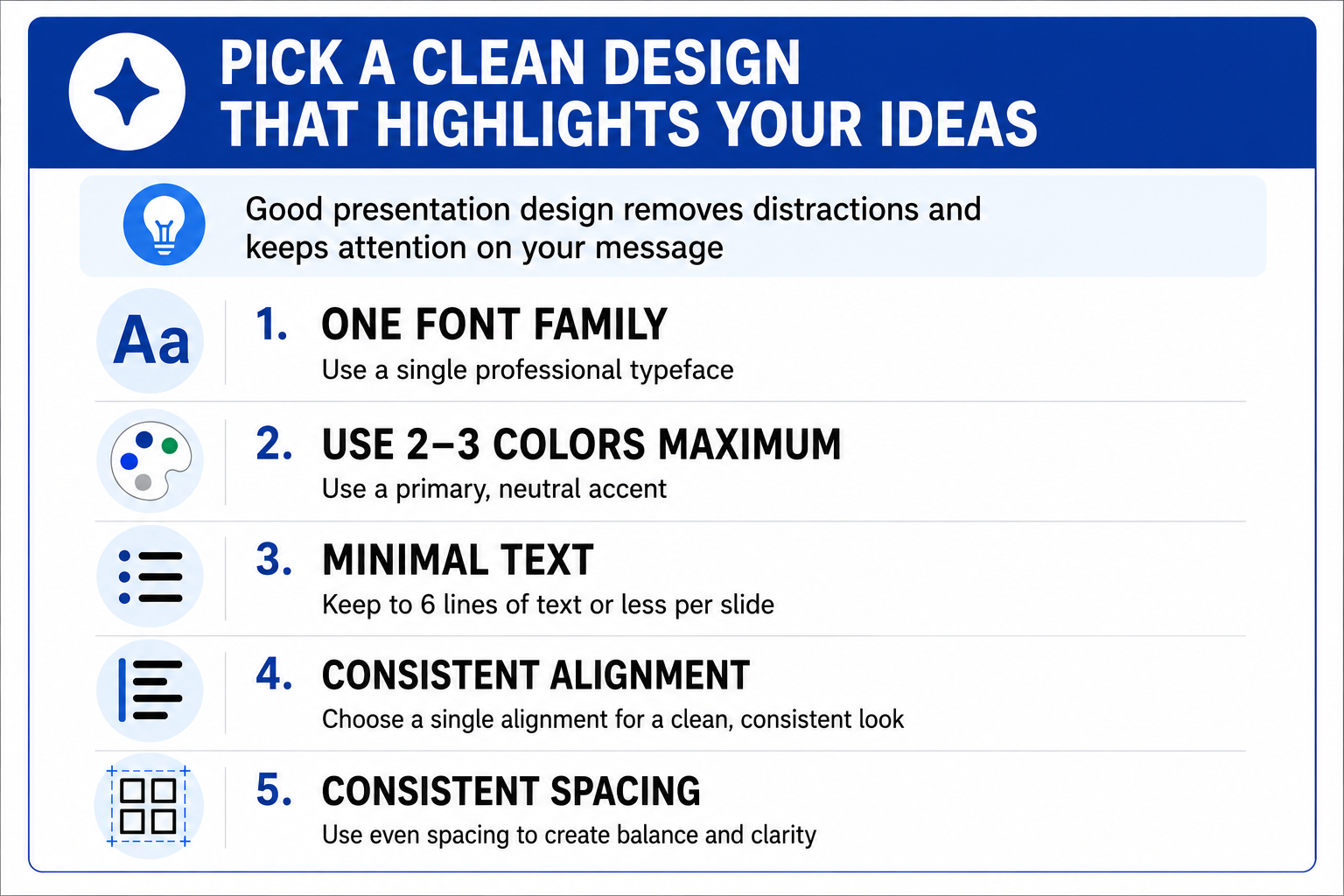
Design is not decoration. In a business presentation, every visual choice either supports comprehension or competes with it. Clean design removes friction so your audience absorbs your message without thinking about the slides. For a quick reference on what works and what does not, these presentation tips cover design fundamentals in depth.
Stick to Visual Minimalism
Flashy templates with gradient backgrounds, heavy animations, and decorative icons pull attention away from your content. Simple layouts with ample white space let your ideas breathe and give the audience room to focus.
Follow these baseline design rules:
Use Visuals That Earn Their Place
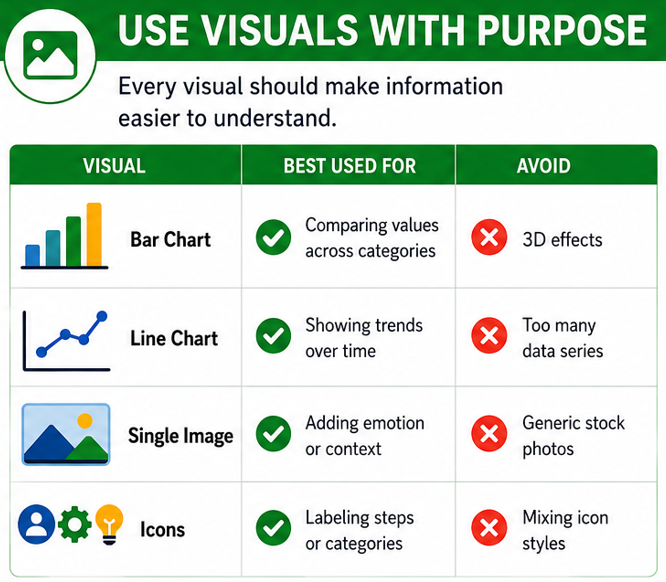
Charts, images, and icons should clarify information, not fill empty space. Before adding a visual element, ask whether it helps the audience understand the point faster than text alone.
Keep Slide Transitions Simple
Every transition or animation adds cognitive load. A simple cut or a subtle fade keeps the audience in your story. Spinning, bouncing, or flying elements signal amateur work and break the professional tone your content needs.
Did You Know: The most effective business presentations often use zero animations. The clarity of the content and the speaker's delivery carry the entire experience.
Practice Your Delivery and Present with Confidence
Presentation skills are built through deliberate practice and a few reliable habits, not innate talent. A polished slide deck means nothing if the delivery falls flat.
Rehearse Out Loud at Least Twice
Silent review of your slides is not a rehearsal. Speaking the words out loud reveals awkward phrasing, sections that run too long, and transitions that feel forced.
Run through the full presentation at least twice before the real event. Time yourself on each pass to confirm you fit your window. Mark any slide where you stumble or lose your thread and simplify that section.
Pro Tip: Record yourself on your phone during a rehearsal. Watching even sixty seconds of playback exposes filler words, pacing issues, and body language habits you would never catch in real time.
Open Strong and Close with a Clear Ask
The first thirty seconds set the tone. Start with a direct statement about why this presentation matters to the people listening. Skip the throat-clearing introductions and the agenda slide nobody reads.
End with a specific action step. Tell the audience exactly what you need from them and by when. A presentation without a closing ask wastes the momentum you built.
Handle Questions Without Losing Control
Questions are a sign that the audience is engaged. Welcome them, but set expectations early. Let people know whether you prefer questions during or after the presentation.
When a question catches you off guard, follow this sequence:
- Acknowledge: Repeat or paraphrase the question so everyone hears it.
- Answer directly: Give the short answer first, then add context if needed.
- Bridge back: Connect your response to a key point in your presentation to keep the conversation on track.
Use AI to Build Your Business Presentation Faster
Planning and structuring a business presentation takes time. Most of that time goes to formatting, not thinking. AI tools now handle the mechanical work, so you spend your energy on the message itself.
Where AI Removes the Bottleneck
The slowest parts of building a presentation are rarely the strategic ones. Choosing layouts, aligning elements, and adjusting spacing across 30 slides can take hours without improving the quality of your ideas. Rewriting bullet points adds to that drain.
AI-powered tools compress that work into minutes. You provide the content direction, and an AI幻灯片创建器 生成结构化、专业设计的草稿,供您完善,而非从零开始构建。
Presentations.AI 如何作为商务演示文稿制作工具发挥作用
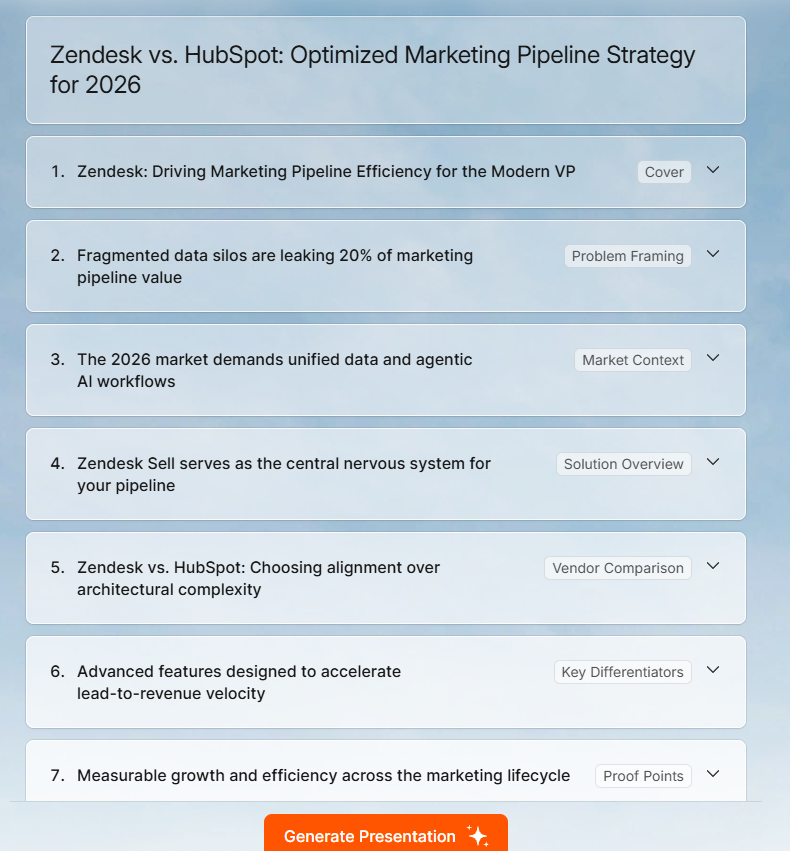
这个 Presentations.AI 演示文稿制作工具 将您的输入转化为完整的幻灯片演示文稿。描述您的主题、受众和目标。该平台会生成一份结构清晰、设计简洁、逻辑流畅且格式一致的演示文稿。
您无需拖动文本框或寻找合适的图表样式,而是直接从一份可用的草稿开始。在此基础上,您可以编辑、重新排列并添加您的具体数据点。创意决策权仍掌握在您手中,而制作工作则不复存在。
在时间紧迫时,这一点尤为重要。明天早上要进行的客户提案,或两小时后要进行的董事会更新,都容不得在格式上纠结。
注意: AI 保留您的专业知识。它消除了您的想法与最终演示文稿之间的繁琐工作,让您在会议上准备充分,专注于交流,而不是因幻灯片格式而筋疲力尽。
何时使用 AI,何时手动创建
AI 最适用于结构和速度至关重要的标准商务演示文稿格式。当您需要快速获得一份简洁的初稿并计划在此基础上进行自定义时,即可使用它。
当演示文稿需要高度定制的视觉叙事或打破传统幻灯片逻辑的格式时,请手动创建。即便如此,与从空白画布开始相比,从 AI 生成的草稿开始并对其进行解构通常也能节省时间。
- 最适合 AI: 客户提案、团队更新、季度审查、内部提案、培训演示文稿。
- 最适合手动创建: 创意活动、品牌发布、带有定制插图的投资者故事。
专业提示: 使用 AI 生成初稿,然后将剩余时间用于排练演示,而不是完善幻灯片边距。这种权衡比任何设计调整都能更好地改善结果。
让每一次演示都至关重要
成功的商务演示建立在清晰的流程之上,而非天赋或昂贵的软件。明确你的目的,了解你的听众,每张幻灯片只围绕一个核心思想,并保持设计简洁。
令人遗忘的演示文稿与能推动决策的演示文稿之间的区别,归结于准备工作。明确的目标能让你的内容保持专注。每张幻灯片一个核心思想能让听众保持投入。简洁的设计能让注意力集中在关键信息上。大声排练能让紧张的演讲者变得自信。
这些步骤需要纪律性,以及愿意删减那些对现场无益的内容。这个框架同样适用于五分钟的团队更新和高风险的客户提案。无论何地的听众都喜欢清晰、有条理和自信的演示。
将每一次演示都视为一次有条理的对话,其中每个元素都有其存在的价值。从目标句开始,只构建支持目标的内容,并走进会场时,准备好引导讨论。时间紧迫时,让AI处理制作工作,这样你就能专注于重要的对话。